Sunday, April 16, 2017

// // Leave a Comment

The Snallygaster


While we have all heard of Bigfoot, the Loch Ness Monster and the Chupacabra, many more regional and rare cryptids exist that few ever hear of. One of these is the Snallygaster of Maryland, particularly found in the hills of the Washington and Fredrick counties.

Descriptions of the beast vary, but in general, it is described as a reptilian bird with hooks on the ends of its feet, a massive beak (possibly made of metal) lined with sharp teeth.It is reported as having claws, but it is also reported as having hooves.At times it has tentacles.It resembles a flying octopus. The noise it makes has been likened to that of a locomotive whistle.

The Snallygaster has one widely known enemy, called Dewayo. The Dewayo is reported to be a mammalian biped with features similar to a wolf, but the stance and stature of a human. The sightings of Dewayo are primarily reported in West Middletown, Maryland, but sightings have also been reported in the Wolfsville, Maryland region. The Dewayo and the Snallygaster have reportedly had vicious encounters dating back to early settlement of the Middletown valley.

The word Snallygaster has its origins in the German phrase "Schneller geist," meaning quick spirit.The area around Middletown Valley was no stranger to strange happenings.Rumors of a beast that would swoop in silently and steal children and chickens pervaded the area from as soon as the first white settlers arrived in the area.There are early references to ghosties and ghoulies that could be the Snallygaster throughout Frederick's history. The documented Snallygaster, however, is a twentieth-century beast. 

The first newspaper article about the Snallygaster appeared in 1909 in the Middletown Valley Register. A smattering of articles appeared during that time. The Snallygaster then went dormant in this area until 1932, when a series of sightings were again reported in the Middletown paper. Some speculate that the second monster was the offspring of the first that had been reported to have been laying eggs. In fact, some men were reported to have found one and tried to incubate it.


The First report of the Snallygaster came from a man named James Harding who saw the creature flying low overhead.  He described the Snallygaster as a huge winged monster with a long sharp beak, claws like steel hooks, and having one eye in the middle of its head.  The monster’s screech he described as “as loud as a train whistle”.

Reports would continue for several months with only one reported fatality. Bill Gifferson was a black man and is said to have been snatched up by the monster, who flew to a nearby hill, pierced his neck and sucked out his blood.  While it dined it flapped its wings and when satisfied, dropped his corpse down the hill.

Sightings of the Snallygaster were creating such a commotion that at one point it was reported that President Theodore Roosevelt might postpone a trip to Europe so that he could lead an expedition to capture it.

Apparently, the Smithsonian Institute was also interested in the beast. From the description provided by engineer 83, at Shepherdstown, West Virginia, they determined the strange beast was either a bovalopus or a Snallygaster, since it had the characteristics of both. Further, its hide was so rare that it was worth $100,000 a square foot, as it was the only substance known to man that could polish punkle shells.

The Snallygaster's travels throughout Maryland are not limited to Frederick County.  It has been seen not only in neighboring Carroll and Washington Counties, cut as far away as Baltimore and Cecil Counties. 

Some accounts place Snallygaster activity in Ohio and West Virginia, communities that have migrant patterns out of Western Maryland. Coincidence - or an illustration of cultural traditions?

While people may have seen less of the Snallygaster as the twentieth century progressed, it was still very much in the minds of Frederick Countians. In the late 1940s, for example, a Thurmont algebra teacher would threaten his less studious charges with the beast.  He also threw erasers at them. It is unclear which threat was more successful.

The Snallygaster finally met his end in a way some might envy. The creature was flying near Frog Hollow in Washington County when it was attracted by the aroma of a 2500-gallon vat of moonshine. As the beast flew overhead, it was overcome by the fumes and dropped into the boiling mash. A short time later, revenue agents George Dansforth and Charles Cushwa arrived on the scene. They had received information about the still, but were rather startled at the sight of the dead monster in the vat.

The two agents exploded five hundred pounds of dynamite under the still, destroying the remains of the Snallygaster and John Barleycorn’s workshop.

A great deal has been written about the Snallygaster since 1909. It has appeared in countless articles in the Middletown Valley Register, Frederick News Post, and other area newspapers. Is has also appeared in the Baltimore Sun, National Geographic, and Time Magazine.

Information about the Snallygaster can be found in several books on Maryland legends.  There is a Snallygaster chapter in both "Spirits of Frederick" (1992) and "Weird Maryland" (2006). The definitive history of the Snallygaster tale was recently published by local researcher Patrick Boyton in "The Snallygaster: The Lost Legend of Frederick County."  
Read More

Thursday, April 13, 2017

// // Leave a Comment

The Fouke Monster


The forests, sparsely populated regions and the Ozark Hills of Arkansas have long made for many mysteries and the strange creatures of the state are no exception. There have been a number of anomalous creatures who have appeared throughout the state over the years.

The "Fouke Monster" - or "Boggy Creek Monster" as it is sometimes referred to - is a Sasquatch-like creature said to haunt the network of creeks extending from the Sulphur River Bottoms in southern Arkansas to the small town of Fouke.It is also known as Southern Sasquatch.Over the years, the creature has been seen by countless people, including respected citizens, experienced hunters, famous musicians, and even a police officer. It has inspired several movies, most notably The Legend of Boggy Creek, which became a drive-in sensation netting nearly $25 million during its run.

Appearance:

Various reports between 1971 and 1974 described the creature as being a large hominid-like creature covered in long dark hair, which was estimated to be about 7 feet (2 m) tall with a weight of 300–500 pounds. Witnesses said that its chest was about 3 feet (1 m) wide.Later reports, published during the early 1980s, claimed that it was far larger, with one report describing it as 10 feet (3 m) tall, with an estimated weight of 800 pounds (360 kg).It has also been reported that the creature's body is covered with dark brown or black hairs.
Some accounts describe the Fouke Monster as running swiftly with a galloping gait and swinging its arms in a fashion similar to a monkey.Reports also describe it as having a terrible odor, the odor being described as a combination of a skunk and a wet dog, and as having bright red eyes about the size of silver dollars.
A variety of tracks and claw marks have been discovered which are claimed to belong to the creature. One set of foot prints reportedly measured 17 inches (43 cm) in length and 7 inches (18 cm) wide, while another appeared to show that the creature only had three toes.


Chronology:

Prior to the 20th-century reports, several reports in the general area have been tied to the Fouke Monster. The two most widely circulated reports focus on an 1851 report in the Memphis Enquirer, and an 1856 report in the Caddo Gazette.
 The first reported sightings of the "Boggy Creek" monster were in 1946, and it was seen again in 1965. But it was an alleged attack on a farmhouse near the Fouke community in 1971 that brought state and national attention to the region south of Texarkana.
Shaggy-haired, stinky and well over six-feet tall, the creature allegedly clawed its way through a screened window before the men of the house chased the creature back into the woods. Law enforcement officers were called and investigated the scene, taking casts of some strange footprints. Soon after the lawmen departed, the beast returned and was met with gunfire from the homeowners, according to reports.
In 1972, Texarkana native Charles B. Pierce produced a low-budget movie called "The Legend of Boggy Creek," which assured a place in folklore history for the Fouke Arkansas Monster. The pseudo-documentary film became a cult hit and reportedly grossed $22 million in ticket sales, mostly at drive-in theaters.
Many people believe that sighting reports of the creature stopped in the mid-1970s after the movie mayhem died down. However, the sighting reports did not halt, nor did they truly start in 1971. Sightings of a large, hairy mysterious creature in the Fouke area date back to the early 1900s and continue right up until today.

Conclusion:


The Beast of Boggy Creek will always be a stand-out among America's spooky legends due to his movie fame, continued popularity, and modern sightings. The creature is often mentioned on television documentaries including Monsters and Mysteries in America, Finding Bigfoot, Mysteries at the Museum, MonsterQuest, Lost Tapes, and Weird Travels.

If you visit Fouke, Arkansas, just remember to keep an eye on the woods just as the sun begins to set. You never know when you just might see the legendary Beast of Boggy Creek!

Source: http://www.foukemonster.net/
Read More

Monday, April 10, 2017

// // Leave a Comment

Lampong


The lampong is an Ilonggot gnome disguised as a one-eyed white deer.Its true appearance is a humanoid creature two feet tall.It wears a tall, black, two-peaked cap. It is bright-eyed and long-bearded. It lives in the forest shepherding wild beasts, risking its life to save them. It beckons men who shoot at these beasts. If someone tries to shoot at it, the first five tries will be without success, giving it time to escape, at least. But when it does get hit, it turns into a Duwende, which by then will give it powers to inflict vengeance.When wounded it retaliates by inflicting a fatal illness to the hunter. Once a hunter was out one night hunting with his bright light in the forest as he came across Two brilliant eyes that showed up and he shot between them but when he search for the animal believe to be a deer Nothing was found. Few minutes he saw the bright eyes again so he shot again and again but never hit the animal until the the sixth time he glimpsed the light fur of a white deer Then immediately it changed form and the hunter saw standing there, a little duwende about two feet high. It had on only a tall two-peaked black cup and a long white beard reaching to the knees. Its eyes were very brilliant. It stood there beckoning to the hunter but just then the rest of the hunting party walk up and saw the duwende. So frightened they ran scream and cried out: “It is the Lampong,” and ran away.
Read More

Sunday, April 9, 2017

// // Leave a Comment

Paja Tomic (Vampire)


Although most Europeans stopped taking vampires seriously by the 20th century, belief in the creatures persisted in some rural areas. In the Bosnian village of Tupanari, for example, in 1923, a case of vampiric manifestation happened in Bosnia. The story started on the death of a village peasant named Paja Tomic on April 9. 1923 (Some says that it was May 1923, but the date May 1923 is the day that the case was published in the local newspaper but based on the book of Alan Dundes  The Vampires: A casebook the incident happened on April 9, 1923).  Soon after his death, his wife named Cvija was alarmed about the sightings of her husband during the night.  She claimed that her husband appeared on random guests and scares the occupants.  She also said that her husband has turned into a vampire.  Some villagers immediately believed her claims but some of them disregarded it.  But when her sons Krsto and Stevo told them that they also have an eerie experience with the vampire, the villagers started to grown weary.

The two siblings called the attention of the town and asked them on what measures they should take in order to repel this evil creature. Finally, they made the conclusion that this vampire should be destroyed.  The two siblings together with some of the town members storm to the cemetery to hunt the vampire.  They exhumed the body of Paja Tomic and struck the corpse with a stake made up of Hawthorn, which they believe has a magical element that strongly opposed the undead element.  They also burned the body of Tomic and dispersed the ashes.  The remaining bones were returned into the grave.

The incident was picked up by a local newspaper. According to the report published on May 23 of 1923:

“…an old peasant Paja Tomic…died…the 9th of April this year.  Shortly after his death, his wife Cvija began to complain that her dead husband had begun to return nights as a ghost and that he ran throughout the house scaring the inhabitants.  There are some who believe Cvija and some who did not, though she has unceasingly asserted that her husband is a vampire and that he returns every night.  Thus things went on for a whole month and then, it is said, her sons also became aware that there was a vampire in the house.            Stevo and Krsto Tomic, the sons of the deceased man, called the whole village to a discussion of what could be done about their father who had become a vampire.  All of the peasants were in agreement that the vampire must be destroyed.  They decided that they must dig up the corpse, burn it and disperse the ashes.  The decision was put into action.  The peasants, armed with pickaxes and shovels, went to the cemetery.  Some carried wood for the fire and one prepared a pointed hawthorn pole.  The peasant crowd, led by the sons of the deceased Paja, arrived at the cemetery.  The corpse was dug up, it was pierced by the hawthorn pole and thrown onto the stakes.  After the body was burned, they dispersed its ashes, and those few charred bones which remained were thrown back into the grave…”
Read More

Thursday, April 6, 2017

// // Leave a Comment

Yacumama


The world is filled with secrets. Many of them it does not give up easily. Empires have risen and empires have fallen in the midst of mysteries-riddles that remained unsolved through the centuries.

One such mystery has haunted the darker, steamier regions of the fabled land of the Amazon.The Amazon, a dark, forbidding river sluggishly twisting its way through Brazil and eight other South American countries. It is a river second in size only to the mighty Nile and it is so wide that no bridge passes over it.

As far back as the Aztecs, legends have been spoken about the monster snakes. The Aztecs of central Mexico made it one of their most powerful gods: Quetzalcoatl.

Quetzalcoatl tasting human flesh.
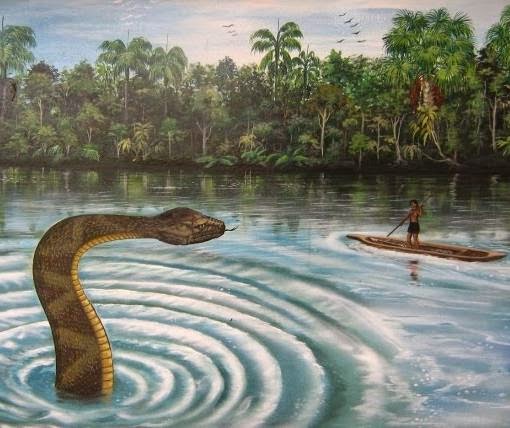
In the centuries that followed, the indigenous people of the Amazon often spoke of the Yacumama—the snake of the water. The Yacumama is a giant anaconda-like snake that has been frightening Brazilians for many years. This immensely strong serpent, capable of sucking up everything around it, has the power to cause mudslides and general chaos. European and American herpetologists shrugged off the talk as myths or as references to the great aquatic boa, the anaconda.

According to the indigenous peoples, other giant snakes inhabit the Amazon's shadowy realm too: the Sachamama and the Minhocão, a snake that some Amazon natives believe can alter the land as they pass through.

Despite the herpetologists' belief, the natives were not speaking of big anaconda by different names. They spoke of true monsters-leviathans so huge that the anaconda would be small in comparison. The snakes the natives sometimes spoke of in fear and awe over village campfires and the safety of their homes—measured 120, sometimes 160 feet long. The heads of these mammoth creatures were said to reach 6 feet wide. They can bring down their prey with explosive jets of water, toppling trees in their passage and change the course of minor tributaries.

During the year 1906, the world-famous explorer Major Percy H. Fawcett claimed of encountering a gigantic anaconda while traveling up the Amazon River. A report from Percy H. Fawcett reads: 
 We stepped ashore and approached the reptile with caution. It was out of action, but shivers ran up and down the body like puffs of the wind on a mountain tarn. As far as it was possible to measure, a length of 45 feet lay out of the water, and 17 feet in it, making a total length of 62 feet.....such large specimens as this may not be common, but the trails in the swamps reach a width of six feet and support the statements of Indians and rubber pickers that the anaconda sometimes reaches an incredible size, altogether dwarfing the one shot by me. The Brazilian Boundary Commission told me of one killed in the Rio Paraguay exceeding 80 feet in length!"

Major Fawcett was inspired by tales of giant anacondas (Picture based in part on a photograph published in the newspaper of Pernambuco, January 24, 1948.)

However, they were far from convinced academic professionals and herpetologists. The monstrous snakes just seemed to be something obviously crazy. As the dispute continued for another century until two brothers, Mike and Greg Warner, mounted an expedition in the jungles of the Amazon looking for evidence of monstrous snakes. The expedition was inconclusive, although recorded mammoth trails giant snake and took testimonies of natives who claimed to have seen the Yacumama.

Mike Warner spoke to hundreds of indigenous and workers who had encounters with Yacumama. He researched thousands more. He noted that certain native tribes of both African and Native near the Amazon River in South America describe an enormous snake "takes water with it." Although the first expedition could not find the elusive Yacumama, the brothers were undeterred. After two new fundraising, they mounted another expedition to the Amazon.

During the second expedition, Warner succeeded in finding and photographing areas where Yacumama lives, gaps are formed near rivers, their trenches (some almost 2 meters wide) and photographing some of the giant snakes, not Yacumama but just as impressive. In fact, their findings are so credible that the National Geographic Society expressed serious interest in the brothers' research and findings.

What they found tallied with the reports of previous witnesses. Through the years, many sightings have included descriptions Yacumama snake with horns sprouting from his head. This peculiar feature, mentioned in many reports of independent observers along the Amazon, has led Warner to the hypothesis that Yacumama could be a prehistoric version of modern day caecilians.Most of the roughly 50 species of caecilians that have been rated have a groove along both sides of the head containing retractable tentacles. To the untrained observer, they may appear as horns. According to Mike Warner, "The exact species of this creature is unknown but we believe that the physical characteristics and behavior are a snake - or amphibians - similarly to a caecilian behavior. " - An amphibious snake-like creature.

A snake photographed in Brazil with a length of 35 meters, 75 cm wide and 4 tons.

Most of the witnesses who have sighted one Yacumama have not spent much time studying the creature -. Been generally passed over it by accident and then gave swing and ran for their lives. Warner's research led him to discover that seeks Yacumama prey near the regions where two rivers merge into one, called "confluence". He determined that those areas provide the colossal predators a steady supply of food. He hypothesizes that this capacity may have one or more of the following purposes:

1. The stunning prey or tear down trees in its path. The Yacumama allegedly swallows water and throws his prey like a water cannon. 
2. while "takes water with it" you may use this water pressure to sustain its skeletal structure, while moving through the jungle . . 
3 You can also use water as an instrument of burrow - like a worm does on the ground, therefore, has some similarity to a Gymnophiona features. The Indians of the Peruvian Amazon witness a loud noise that can be heard when the Yacumama this game during the rainy season.

All sightings of these giant snakes have similar descriptions. Warner believes that the snakes that the natives call the Sachamama - mother earth - are the same as the Yacumama snakes. Have grown so large that they have become virtually immobile and therefore no longer feed on prey caught in the water. He extrapolates this hypothesis: "At this point we can release pheromones to attract snakes of the same species and so eat them This process can even restrict the population of this species in a given area.."

Perhaps Yacumama are real.They can even be a previously undiscovered species. They are also, without a doubt, some of the most dangerous and terrifying predators in the animal kingdom.


Read More

Sunday, April 2, 2017

// // Leave a Comment

2,000-year-old pre-Aztec ancient palace complex found in Mexico


A palace complex believed to be the home and business center for the ruler of an ancient empire dating back to over 2,000 years has been discovered in Mexico. The palace has been dated to approximately 2,100 to 2,300 years ago, a time before the Aztecs, researchers said.
The palace is well preserved and covered about 2,790 square meters. The construction techniques used by the builders suggest the building was designed ahead of time and that it was likely a single construction effort that would have taken a lot of organization, researchers said.
Its large size demonstrated that the ruler had a lot of manpower at his disposal. The researchers also note that personal details are still evident in some parts of the palace, such as the cistern for collecting rainwater in the residential quarters and the drain carved into stone to bring in fresh water and remove waste.
The civilization that existed in Oaxaca is believed to be among the earliest states to come into existence in Mesoamerica. Researchers Elsa Redmond and Charles Spencer of American Museum of Natural History suggest that their findings at the palace site backs up that theory.


The Oaxaca Valley near the southern tip of Mexico has been offering up clues of past civilizations for several decades – a team has been working at the El Palenque site in particular since 1993, ‘Phys.org’ reported.
The El Palenque palace exhibits certain architectural and organizational features similar to the royal palaces of much later Mesoamerican states described by Colonial-period sources, researchers said. The royal palace was multi-functional and had courts and buildings for government officials to conduct state affairs as well as residential quarters for the rulers, according to the paper which is published in the Proceedings of the National Academy of Sciences. It also had a staircase, dining area and space to perform sacrifices. There are even personal details in parts of the palace such as a cistern for collecting rainwater and a stone drain to bring in fresh water and remove waste.  
Using radiocarbon dates, researchers found that the palace was built in a single construction effort during 300-100BC. 

Read More
// // 1 comment

Highgate Vampire

Highgate Cemetery was constructed in 1839, but by the 1960's it had fallen into neglect and decay.Overgrown and sprawling, the gothic Victorian graveyard seemed the perfect setting for the strange and sinister events that would follow.

In the early 1970s, a wave of panic spread around the north London suburb of Highgate. There was a vampire on the loose.Tales of the sinister ghostly figure and bizarre occult rituals at the famous local cemetery had led many residents to fear for their safety.


Although Highgate cemetery had long been a hotspot for ghost sightings, the local and national media would soon come to seize on this particular apparition.

Chronology:


In the 1960's and early 1970's, many people reported to the local newspaper, the Hampstead and Highgate Express that in the early evening they had seen a figure that they took to be the Highgate Vampire inside Highgate's Western Cemetery near the main gate. The phantasm was described as a tall, red-eyed man wearing a black cloak and tall black hat. When the newspaper published the reports, thousands of people flocked to the cemetery in the hope of catching a glimpse of the spectre.


At that time, the Western Cemetery was in an appalling condition. The graves and tombs were overgrown and the graveyard was vandalized. Bones could often be seen falling out of rotting coffins and also from those coffins that had deliberately been set ablaze by vandals. The cemetery even had its own 'satanic cult' that frequented the place after dark. They used the easily obtained bones along with small animals which they caught and killed, in their 'rituals'.

In 1963 two 16-year-old convent girls were walking home at night after having visited friends in Highgate Village. Their return journey took them down Swain's Lane which passed along cemetry's north gate.What they encountered was so terrible they were frozen to the spot, transfixed with fear.


They had come face to face with what would later become known as the Highgate vampire. A tall, dark figure, floating behind the railings. Its face was the worst thing, a ghoulish nightmare contorted in horror. 


More sightings would follow. A man walking his dog saw the same tall dark figure sliding over the wall along Swain’s Lane like ‘black treacle’. In 1971 several years after the many publicised vampire sightings, a young girl claims she was actually attacked by the vampire in the lane outside the cemetery. She was returning home in the early hours of the morning when she was suddenly thrown to the ground with tremendous force by a "tall black figure with a deathly white face. At that moment a car stopped to help her and the vampire "vanished" in the glare of the headlamps.


She was taken to the police station in a state of shock, luckily only suffering abrasions to her arms and legs. The police immediately made a thorough search of the area, but could offer no explanation to the incident. More mysterious still was the fact that where the vampire vanished, the road was lined by 12ft walls.


Another interesting case is that of the man who was hypnotised by something in the cemetery. He had gone into the cemetery one evening to look around, and as the light began to rapidly fade he decided to leave, but became hopelessly lost. Not being a superstitious person he walked calmly around looking for the gate when suddenly he became aware of something behind him. Swinging around he became "hypnotised with fear" at the tall dark figure of the vampire confronted him. So great was the intensity of his fear that he stood motionless for several minutes after the vampire vanished. He later recalled that it was almost as if he had been paralysed with fear by some force.

A group calling itself the 'British Psychic and Occult Society' decided to investigate the Highgate Vampire. Members visited the cemetery one night, cast a 'protective circle' and attempted to invoke the demon. The police had been warned and when they turned up, the society members scattered. Their president, David Farrant, was caught and arrested. A wooden stake was found in his possession. It was pretty obvious the use to which they planned to put it. At the subsequent court case, Farrant was acquitted because Highgate Cemetery was legally open to the public at any time of the day or night.

The society allegedly gave up its investigations of the vampire in 1973. However, David Farrant was again in court in 1974 in connection with Highgate Cemetery. He was charged with maliciously damaging a memorial, interfering with a dead body, attempting to influence witnesses and, most seriously, possession of a firearm. For this latter offense, Farrant spent some time in prison.

However, David Farrant wasn't the only one looking for the Highgate Vampire. Sean Manchester of the 'British Occult Society' said that he was investigating phenomena at the cemetery in 1967. He claimed to have discovered several girls who had the traditional puncture marks on their necks after they had visited the cemetery. A couple of them even involuntarily sleep-walked. In this state, one girl is supposed to have made her way back to the cemetery at night and Manchester saved her by throwing a crucifix in her path. 


Manchester told the media the date when he intended to lay the Highgate Vampire and hundreds of people turned up to watch. Despite police being there, Manchester and his friends managed to make a hole in the roof of a tomb. Inside they found three empty coffins. These, they sprinkled with garlic and holy water and put a circle of salt around each.


In an interview with the Hampstead and Highgate Express in February 1970, Manchester claimed the figure was a ‘King Vampire’, an undead 15th-century Romanian nobleman who had practiced black magic in Wallachia, the home of Dracula himself.Traveling to England, he had somehow ended up buried in what would become Highgate. Manchester told the paper that the vampire had been revived by the activity of the Satanists that were said to operate at the cemetery.


The people interred in Highgate Cemetery can now rest in peace. The vampire has gone and those intent on desecration can no longer get in at night.


In 1975, the Friends of Highgate Cemetery was set up. They cleaned up the graveyard, provided proper gates and had the remains they found out of place respectfully re-intered. The FOHC now provide a guided tour of Highgate Cemetery which is absolutely fascinating.


Read More