Saturday, October 28, 2017

// // Leave a Comment

Scorching hot exoplanet 'snows' sunscreen

Artist’s illustration showing the scorching-hot exoplanet Kepler-13Ab, which orbits very close to its host star, Kepler-13A.
Astronomers have observed an extrasolar planet with some of the weirdest weather conditions ever seen.

Six times more massive than Jupiter and situated at a distance of 1,730 light years from the Earth, Kepler-13Ab, with often sees dayside surface temperatures of up to 5,000 degrees Fahrenheit, is one of the hottest extrasolar planets ever discovered,
 Kepler-13Ab is "tidally locked," always showing the same face to its star. So, it has a dayside and a nightside.)

Situated extremely close to its parent star and with an orbital period of 1.8 Earth days, this distant world is tidally locked so that one side of the planet is always facing its star.

Now astronomers believe that strong winds may also carry titanium dioxide - one of the active ingredients in sunscreen - around to the planet's cooler side where it condenses in to clouds.

The peculiar 'snow' then falls in to the lower atmosphere where it stays due to the planet's gravity.

"These observations of Kepler-13Ab are telling us how condensates and clouds form in the atmospheres of very hot Jupiters, and how gravity will affect the composition of an atmosphere," said study lead author Thomas Beatty from Pennsylvania State University.

"When looking at these planets, you need to know not only how hot they are, but also what their gravity is like."

"In many ways, the atmospheric studies we're doing now on these gaseous, 'hot Jupiter' kinds of planets are test beds for how we're going to do atmospheric studies of terrestrial, Earth-like planets," he said in the same statement. "Understanding more about the atmospheres of these planets and how they work will help us when we study smaller planets that are harder to see and have more-complicated features in their atmospheres." 

As its name suggests, Kepler-13Ab was discovered by NASA's planet-hunting Kepler space telescope, back in 2011. The planet is part of a triple-star system that includes the hot Jupiter's host star, Kepler-13A, and two companion stars (Kepler-13B and Kepler-13C).
Read More
// // Leave a Comment

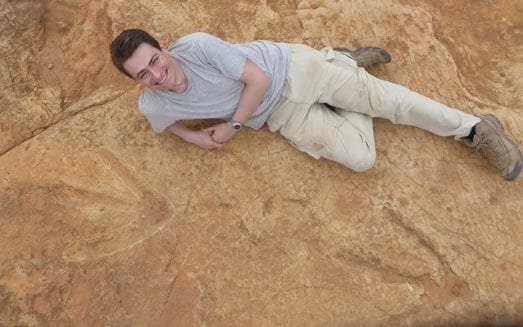
'Mega-carnivore' dinosaur found in Africa

An enormous meat-eating dinosaur measuring up to 30ft in length once roamed what is now Southern Africa.

Discovered by a team of researchers from universities in the UK, South Africa and Brazil, this prehistoric behemoth was part of a group of carnivorous dinosaurs known as 'megatherapods'.

Its footprints were found in the Maseru District of Lesotho - a small country in Southern Africa.

The discovery of such a large carnivorous dinosaur dating back to the Early Jurassic epoch was particularly unexpected as meat-eaters from that time were typically much smaller.

"The latest discovery is very exciting and sheds new light on the kind of carnivore that roamed what is now Southern Africa," said Dr Fabien Knoll from the University of Manchester.

"That's because it is the first evidence of an extremely large meat-eating animal roaming a landscape otherwise dominated by a variety of herbivorous, omnivorous and much smaller carnivorous dinosaurs. It really would have been top of the food chain."
Read More

Wednesday, October 25, 2017

// // Leave a Comment

Supervolcano could erupt sooner than previously thought.

The enormous supervolcano in Yellowstone National Park could erupt with only a few years' warning.

The natural beauty and hot springs of Yellowstone National Park attract thousands of tourists from all over the world on an annual basis, but not far below the park's serene surface is an increasingly large chamber of molten hot magma with the potential to erupt at any time.

When the inevitable does eventually happen, the Yellowstone supervolcano will cause untold devastation across hundreds of square miles and impact the climate on a global level.

The last time an eruption occurred was 631,000 years ago, suggesting that another one is long overdue, however exactly when this might happen has long remained a bit of a mystery.

Now scientists studying fossilized ash deposits from earlier eruptions have reached the unsettling conclusion that a future eruption could occur with far less warning than previously thought.

Rather than knowing about such an eruption centuries or even thousands of years in advance, we may only have mere decades to prepare and perhaps even less time than that.

"It's one thing to think about this slow gradual buildup - it's another thing to think about how you mobilize 1,000 cubic kilometers of magma in a decade," said geochemist Kari Cooper.
Read More

Monday, October 23, 2017

// // Leave a Comment

New prehistoric marine predator discovered


Palaeontologists have identified a new species that could shed light on the origins of crocodiles.

Nicknamed the 'Melksham Monster' after the town in England where it was first discovered, the 10ft predatory reptile, which dates back 163 million years, is officially known as Ieldraan melkshamensis.

The find is particularly interesting because the Geosaurini - the sub-family of prehistoric crocodiles to which this new species belonged - was previously believed to have arisen much later.

"It's not the prettiest fossil in the world, but the Melksham Monster tells us a very important story about the evolution of these ancient crocodiles and how they became the apex predators in their ecosystem," said Davide Foffa, a PhD student at Edinburgh University.

"Without the amazing preparation work done by our collaborators at the Natural History Museum, it would not have been possible to work out the anatomy of this challenging specimen."

Ieldraan melkshamensis was undoubtedly one of the most fearsome predators of its time and would have dominated the warm, shallow seas of the Middle Jurassic.

Its huge jaws and razor-sharp serrated teeth would have no doubt spelled certain doom for any hapless creature unfortunate enough to have caught its gaze.

Source: BBC News
Read More

Friday, October 20, 2017

// // Leave a Comment

Can Aliens observe the earth?

Astronomers have identified nine planets from which intelligent aliens could possibly be watching us.

While much work has been done over the years to look for signs of intelligent life out there in the cosmos, there has been little consideration of the possibility that someone might be watching us.

In a recent study, scientists from Belfast set out to determine where the best vantage points would be for an extraterrestrial civilization who wanted to observe what we were up to.

The research involved identifying the parts of the sky from which the planets in our solar system could be seen passing in front of the Sun from the perspective of a distant observer on another world.

Surprisingly, it turned out that the rocky terrestrial planets such as the Earth and Mars would be the easiest to spot.

"Larger planets would naturally block out more light as they pass in front of their star," said Robert Wells from Queen's University Belfast. "However the more important factor is actually how close the planet is to its parent star. Since the terrestrial planets are much closer to the sun than the gas giants, they'll be more likely to be seen in transit."

The scientists ultimately detected 68 extrasolar planets from which at least some of the planets in our solar system could be observed and at least 9 that would be "ideally placed" for observing the Earth.

None of these planets however are currently believed to be habitable.

Read More

Wednesday, October 18, 2017

// // Leave a Comment

'Vampire' kangaroos lived longer than thought

An extinct species of fanged kangaroo survived five million years longer than previously believed.

An analysis of fossilized teeth discovered at the Riversleigh World Heritage Area in north Queensland has revealed that these wallaby-sized fanged marsupials went extinct around 10 million years ago, which is five million years later than earlier studies had suggested.

The discovery means that existing extinction theories concerning the species will now have to be thrown out because the timing of their disappearance no longer fits.

"Northern Queensland was predominantly covered in rainforest when these fanged kangaroos first appear in the fossil record," said Univesity of Queensland PhD student Kaylene Butler.

"Every hypothesis we have about their extinction doesn't line up with the timing of when they went extinct so we kind of have to start from scratch now."

There are however two major events at the time of their disappearance that could help to explain it.

"You were starting to see the extension of open grasslands and open woodlands and at the same time you were also seeing potential ancestors of modern kangaroos on the scene," said Butler.

"Potentially the answer is that the fanged kangaroo was outcompeted in food and resources."

Read More

Sunday, October 15, 2017

// // Leave a Comment

China's space station is falling back to Earth


The Chinese space agency's Tiangong 1 space lab is going to hit the ground within the next few months.

Launched back in 2011, Tiangong 1 - or 'Heavenly Place' - was part of China's efforts to assert itself as a major player in the space industry and to create a manned orbital laboratory for scientific research.

Last year however, following months of speculation over peculiarities observed in Tiangong 1's orbit, China's CNSA space agency revealed that it had lost control of the station and that it would be plummetting back to Earth, sparking fears over the risk of falling debris.

Most recently, it has emerged that the station's descent has accelerated and that there is a high chance that it will crash-land either before the end of this year or at the beginning of the next.

While it is next to impossible to predict exactly where it will come down, the chances of it striking a populated area are extremely remote and it is a lot more likely to fall in to the ocean.

Most of the debris will have also burnt up in the atmosphere long before it reaches the ground.
Read More