Friday, February 28, 2020

// // Leave a Comment

Temporary 'minimoon' discovered orbiting Earth

A tiny natural satellite that may have been in orbit for as long as three years has been spotted by scientists.

There's no denying that our planet's orbit has become an increasingly busy place over the last few decades with as many as 5,000 satellites and several million pieces of space debris circling high above our heads.

Not everything in orbit around the Earth is man-made however; also up there at any given time are one or more minimoons - tiny space rocks (at least relative to the actual Moon) that enter into orbit for a brief time before venturing back out into space.

Detecting these pint-sized visitors however has proven quite the challenge - so far only a single minimoon has ever been conclusively identified - a 3ft-long object known as 2006 RH120 which arrived back in 2006 and left orbit again a mere 18 months later.

Now astronomers at the University of Arizona's Steward Observatory believe that they may have discovered a second minimoon - an object named 2020 CD3.

Thought to be up to 11.5ft long, this temporary natural satellite may have been in orbit for up to three years, however there are indications that it could be making its escape within the next few months.

According to Kacper Wierzchos, a senior research specialist for the Catalina Sky Survey (CSS), the object's brightness is typical of most carbon-rich asteroids.

Assuming it maintains its current orbit, it will likely depart again sometime in April.  
Read More

Wednesday, April 10, 2019

// // Leave a Comment

First ever black hole image released

First ever black hole image released

 
Read More

Sunday, April 7, 2019

// // Leave a Comment

NASA Discovers an Exocomet Orbiting an Alien Star

NASA Discovers an Exocomet Orbiting an Alien Star.


Read More

Friday, March 29, 2019

// // Leave a Comment

Hubble Captures Formation of a Giant Storm On Neptune

Hubble Captures Formation of a Giant Storm On Neptune:

Read More

Sunday, March 24, 2019

// // Leave a Comment

NASA is planning to return to the moon.

NASA is planning to return to the moon.


Read More

Saturday, March 23, 2019

// // Leave a Comment

Tachyon: A faster than light particle

A tachyon or tachyonic particle is a hypothetical particle that always travels faster than light. Most physicists believe that faster-than-light particles cannot exist because they are not consistent with the known laws of physics.

Read More

Friday, March 22, 2019

// // Leave a Comment

Multiple realities can exist at the same time

A mind-boggling quantum physics experiment has seemingly confirmed the existence of multiple realities.

The research sought to answer a decades-old physics question first posed by physicist Eugene Wigner in the 1960s. Known as "Wigner's friend", the idea puts forward a situation in which an observer in an isolated laboratory measures the polarization of a photon.

Initially, the photon is in a state of superposition - meaning that its polarization is both horizontal and vertical at the same time. When the laboratory observer measures the polarization, the particle assumes a fixed state, however for someone outside the laboratory who doesn't know the result of the measurements, the photon is still in a state of superposition.

The reality of both these individuals, therefore, differs - even though both are technically correct.

Now, several decades on, scientists have finally been able to conduct an experiment to actually test this concept and demonstrate that, in quantum physics at least, multiple realities can exist.

"Theoretical advances were needed to formulate the problem in a way that is testable," said study co-author Martin Ringbauer from the University of Innsbruck in Austria. "Then, the experimental side needed developments on the control of quantum systems to implement something like that."

The findings seemed to confirm that Wigner's observations held up in practice.

"It seems that, in contrast to classical physics, measurement results cannot be considered absolute truth but must be understood relative to the observer who performed the measurement," said Ringbauer.

Source: Live Science
Read More

Sunday, March 17, 2019

// // Leave a Comment

Top Ten Amazing Facts About Albert Einstein

Albert Einstein is a name synonymous with genius.Here are top ten amazing facts about one of the greatest physicists of 20th century.

Read More

Friday, March 15, 2019

// // Leave a Comment

28,000 years old Mammoth cells brought back to life

A team of scientists in Japan has successfully coaxed activity from 28,000-year-old cells from a frozen mammoth implanted into mouse cells, but the woolly mammal is unlikely to be walking among us soon.

The project by an international team took cell nuclei from a well-preserved mammoth discovered in 2011 in Siberian permafrost and placed them into several dozen mouse egg cells.
Of those, five displayed the biological reactions that happen just before cell division begins, said Kei Miyamoto, a member of the team at Kindai University in western Japan.
None, however, produced the actual cell division needed for a mammoth rebirth, the researcher told AFP.
"This suggests that, despite the years that have passed, cell activity can still happen and parts of it can be recreated," he told AFP.
"Until now many studies have focused on analysing fossil DNA and not whether they still function," he added.
The research — published Monday in the journal Scientific Reports — doesn't provide much hope for Jurassic Park-style resurrection of long-extinct species just yet, he cautioned.
"We have also learned that damage to cells was very profound."
"We are yet to see even cell divisions. I have to say we are very far from recreating a mammoth."
The university has worked with other Japanese and Russian institutes to study and to possibly clone the mammoth and plans to study alternative methods to bring the prehistoric giant back to life.
"We need new technology, we want to try various approaches," Miyamoto said.
Source:The Daily Sabah
Read More

Tuesday, March 12, 2019

// // Leave a Comment

Top 5 Ambitious Future Space Missions

Here are the top 5 space missions which show the curiosity of human beings to explore the last frontier.
Read More

Friday, March 8, 2019

// // Leave a Comment

Edinburgh's Blair Street Vaults

 
There are few places in the world quite as haunted as the Edinburgh's Blair Street Vaults. Also known as South Bridge vaults or just Edinburgh Vaults, the place consists of a series of nineteen chambers arches. The vaults were home to local taverns and shops but later became a safe haven for thieves, murderers and all sorts of nasty figures, making it one of the most dangerous places in the city.

Eventually, living conditions proved to be unsuitable even for these criminals, who could no longer tolerate the poorly circulated air and lack of sunlight, running water, and sanitation. Things became so bad that by the 1860s, most of the vaults had been emptied and filled with rubble, so as to prevent flooding and discourage ongoing crime.

Legend:

According to many paranormal investigations, the Edinburgh Vaults are reportedly one of the most haunted locations in the world. Mustering up all of our courage, our group went on a ghost tour of the vaults, learning of the spirits that still roamed its corridors from the 17th and 18th centuries. 

One of the famed ghosts is known as “Mr. Boots,” an evil entity who is believed to have murdered a woman and kept the body in his “house” inside. He hates the people who tour the vaults, and allegedly gets angry or even attacks anyone who dares to sit in the spot where the body was hidden. The most common reports of his presence, however, are the sounds of thick, heavy boots, stepping ever so slowly around visitors.

A woman described her encounter with Mr. Boots as:

“She told us of the presence of a malevolent male ghost who was very strong… he told her to get out of the vaults… She had tried to reason with him but he made a lunge at her and she saw him very clearly… He said ‘get out’ repeatedly. He was very territorial.”
There are also some other spirits which are not so terrifying. One is called "The Aristocrat", who is a well-to-do gentleman with a tall black hat and beard and is often seen leaning against the wall between the double height room and the tavern. With folded arms, he watches and grins at people as they pass. The other is called "The Cobbler" who is believed to be a shoemaker from the late 18th century, he is described as a short, stocky man wearing a long leather apron and a white shirt. He is known to smile at people as they pass, and is generally felt as a positive presence.

There is also a young spirit called "The Child". He is a small boy who wanders through the vaults, aged at about six or seven. He is described as having “blonde, curly hair and is dressed in a smart, blue suit with knicker-bocker trousers.”
Other unusual occurrences have also been reported around the vaults, with a member of staff at an adjoining bar once reporting leaving an orange on the counter for a few seconds while he put something in the bin, only to find it perfectly peeled when he looked back.

Investigation:

In 2001, Professor Richard Wiseman conducted a study of people spending time the vaults and concluded that, since those people who believed in ghosts reported more supernatural occurrences that those who did not believe, and since there were more “sightings” and odd events in rooms the participants had been told were haunted, that much of the experience was created in the minds of the people who went in there.

In contrast to this however – and perhaps lacking the academic credentials of Professor Wiseman – was Joe Swash, who spent a night in the vaults by himself in 2009 for a BBC programme, during which his microphone supposedly recorded the voice of a Catholic priest reciting the last rights for 20 minutes, something Swash himself never heard.
Others take down Electronic Voice Recorders, light meters and other ghost-hunting gadgets, and invariably all report strange, unexplainable readings.

For those that work there, however, there’s no need for any specialist equipment - just nerves of steel to go down into the dark vaults after everyone else has left the building.
Historical paranormal locations, like the Edinburgh Vaults, that embrace their haunted legacies are some of the coolest places to visit, because not only are you getting the opportunity to step back in time, you might even get to interact with the spirits who were there when it all happened.

Read More

Thursday, March 7, 2019

// // Leave a Comment

Thunderbird


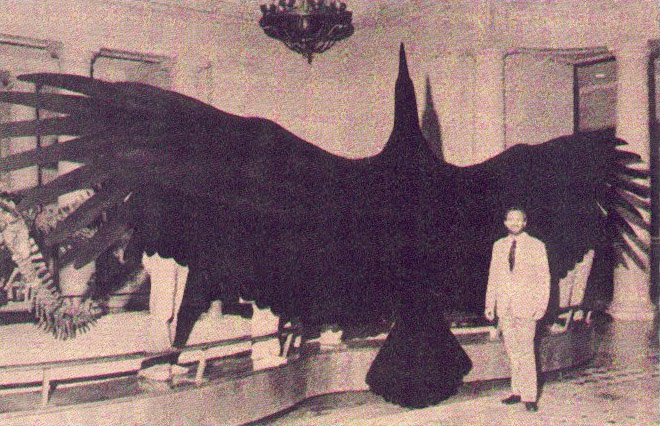
The Thunderbird is a cryptid of North America.Thunderbirds inhabit the folklore of many regions. The name Thunderbird is derived from the sound that is apparently produced as a result of the thunderous beating of the mighty wings of the creature.Tales of similar creature often appear in Native American mythology; some tales tell of enormous eagles strong enough to carry whales back to their nests. Since pioneers began moving west across the North American plains, sightings of large birds have been reported. Similar stories appear from civilizations around the world.

Legend:

Native tribes all across North America, especially along the Pacific coast and in the Great Lakes area, have stories depicting enormous birds of prey. Some stories told that these birds were so large and powerful that when they flapped their wings, thunder was created. Lightning flashed out of their eyes, and water fell off their backs, creating rain. 


The tribes used thunderbirds to explain some of the things that happened naturally, such as storms and other forms of weather. The legend of Passamaquoddies, for example, describes the quest of two Indians in search of the source of thunder high in the mountains. Other stories said that there was a thunderbird who battled an enormous killer whale. When the two beasts fought, they destroyed much of the land, knocking down trees and causing much destruction. 

Although dangerous and powerful beings, thunderbirds were also seen as benevolent nature spirits, and they sometimes assisted the tribes in their search for food during periods of famine.According to some legends,the igneous rocks known as thunderstones are the eggs of these creatures.

Sightings:

Sightings of large bird-like creatures have been reported for many years, ever since people began settling further west in the United States and Canada. 

One of the most famous reports is from 1890, where two Arizona cowboys claimed to have shot and killed a large bird. It was described as having no feathers, and it had the head similar to that of an alligator. The two men supposedly dragged the dead bird back to town after killing it. The report seems to suggest that this creature looked more like a pterodactyl or a dragon than any modern-day bird.

Jeromy Clark in his book Unexplained!, lists many more sightings,including:

  • In the early 1940s, writer Robert R. Lyman spotted a Thunderbird sitting on a road near Coudersport, Pennsylvania. It soon took to the sky, spreading its 20-foot wingspan.
  • In 1948, several witnesses along the Illinois-Missouri border sighted a condor-like bird about the size of a Piper Club airplane
  • In 1969, the wife of a Clinton County, Pennsylvania, sheriff saw an enormous bird over Little Pine Creek. She said its wingspan appeared to be about as long as the creek was wide—about 75 feet!
  • In 1970, several people saw the gigantic bird "soaring toward Jersey Shore [Pennsylvania]. It was dark colored, and its wingspread was almost like [that of] an airplane."

Another sight occurred recently, on the evening of Tuesday, September 25, 2001, a 19-year-old claimed to have seen an enormous winged creature flying over Route 119 in South Greensburg, Pennsylvania. The witness's attention was drawn to the sky by a sound that resembled "flags flapping in a thunderstorm." Looking up, the witness saw what appeared to be a bird that had a wingspan of an estimated 10 to 15 feet and a head about three feet long.


Conclusion:

The possibilities for an explanation are endless.There’s something marvelous about the notion that a giant, man-eating bird of native lore could still be prowling the skies of the Midwest.
Read More

Saturday, February 2, 2019

// // Leave a Comment

Expedition sets out to locate Shackleton's ship


Researchers with the Weddell Sea Expedition are hoping to find the wreckage of Shackleton's vessel Endurance.

Believed to lie 3,000 meters beneath the freezing waters of the Antarctic, the famed vessel, which carried Shackleton and his crew on the Imperial Trans-Antarctic Expedition in 1914, has long been sought-after due to its role in one of the most incredible adventure stories of the modern age.


Shackleton had aimed to lead the first ever land crossing of the Antarctic continent, however the plan was abandoned after the loss of his vessel left he and his crew stranded in the middle of nowhere.


After spending months camped on drifting sea ice, the crew ended up on Elephant Island - an isolated location hundreds of miles from the nearest settlement or shipping route. 


In an effort to find help, Shackleton and a few of his men set out across the ocean in a tiny boat to reach the island of South Georgia which was situated approximately 720 nautical miles away.


After several perilous weeks at sea, they finally arrived on the island. Shackleton and two of his men then had to cross the mountainous terrain of the island on foot to reach an occupied whaling station.


Incredibly, in the end, every single member of his crew was rescued.


Now Professor Julian Dowdeswell and colleagues are hoping to make history themselves by tracking down the last known location of the Endurance and using robotic submersibles to find the wreck.


Even getting to the site however will be an endeavour worthy of Shackleton himself.


"We've got a journey of several hundred km from where we are now through really heavy and quite difficult sea-ice," said Prof Dowdeswell.


"We shall do our best to get there with the excellent ice-breaker that we have, but in any given year it will be very difficult to judge whether you will be able to penetrate the sea-ice."


With any luck, the ship itself will still be relatively intact on the sea floor.


"I think that if we locate the Endurance, the greater likelihood will be that her hull is semi-upright and still in a semi-coherent state," said marine archaeologist Mensun Bound.


"However, on the evidence of the only deep-water wooden wreck I have been privileged to study, I must concede that there is every possibility that she could have been wrenched wide open by impact (with the seafloor), thus exposing her contents like a box of chocolates."


Source:BBC News
Read More

Sunday, December 30, 2018

// // Leave a Comment

Kentucky woman reports '7ft tall creature'

The woman and her husband had been driving near Sandy Hook when they saw something in the road.

The report, which was submitted to the Bigfoot Field Researchers Organization, describes how the couple had encountered a large bipedal creature just after 7:45pm on October 18th.

It was described as "very big in stature, thick legs, thick abdomen... at least 7ft tall" as well as being "the color of a tree, specifically the trees in that area, so like a grayish-brown, very earthy-tone."

The woman's husband, whose eyes were on the road at the time, saw only a "strange shadow".

Due to the mountainous nature of the area, the creature - whatever it was - must have descended a steep incline to reach the road and then dropped down another steep incline on the other side.

After the incident, the couple returned to the same location but couldn't find anything unusual.

"That night, the neighborhood dogs were behaving very strangely, barking and howling all night long," the woman added. "One of them even acted as if he could see something in the distance, and began to growl and stalk before he took off to chase it. It was a very weird night."
Read More

Monday, November 26, 2018

// // Leave a Comment

NASA InSight lander heads for "7 minutes of terror"

 NASA's InSight lander will be descending 80 miles through the Martian atmosphere in a few hours.

Having traveled more than 89 million miles since its launch from Vandenberg Air Force Base back in May, the ambitious spacecraft is currently on track to reach Mars on November 26th.

Just like the previous surface missions, InSight must survive the '7 minutes of terror' - the time it takes for a probe entering Mars' thin atmosphere at hypersonic speed to slow to walking pace and gently put itself on the ground.

"Landing on Mars is hard. It takes skill, focus and years of preparation," said Thomas Zurbuchen, associate administrator for NASA's Science Mission Directorate.

"Keeping in mind our ambitious goal to eventually send humans to the surface of the Moon and then Mars, I know that our incredible science and engineering team - the only in the world to have successfully landed spacecraft on the Martian surface - will do everything they can to successfully land InSight on the Red Planet."
If InSight survives the descent, the $1 billion lander will attempt to learn more about what lies beneath the surface of the Red Planet using an array of sensitive instruments including a burrowing temperature sensor and a seismometer designed to detect Marsquakes. Its mission is to determine the red planet's internal structure.

"This mission will probe the interior of another terrestrial planet, giving us an idea of the size of the core, the mantle, the crust and our ability then to compare that with the Earth," said NASA Chief Scientist Jim Green.

"This is of fundamental importance to understand the origin of our solar system and how it became the way it is today."


For the team, touching down on the surface of Mars will represent years of hard work and preparation ending in a single event.
Read More

Saturday, October 27, 2018

// // Leave a Comment

Black Mountain

The Black Mountain, known to the Aboriginals as Kalkajaka meaning ‘the place of the spear’, is located in Queensland, Australia. The area is a national park and has a unique range of wildlife, including species that are endemic only to this area, many of which are rare.

Appearance:

The mountain is made up of large piles of black granite rocks and huge granite boulders, some of which are said to be the size of small houses. According to geologists, these rocks and boulders were formed 250 million years ago by solidified magma formation and the absence of soil to fill in the gaps and cracks between the rocks means there are many tunnels and caves within the mountain. The black granite also serves to give it a very dark and eery appearance. 

Legends:

As you would expect from such a spooky place it is rich in legend and folklore. The Aboriginal call it the mountain of death. The legends of the mountain are taken very seriously by the local aboriginal people and they are said to avoid the place like the plague. There are so many caves, tunnels and mazes within this mountain making it very easy to get lost. The mountain is known for some very strange sightings and disappearances and the natives have a lot of very disturbing stories surrounding the Black Mountain. 

One of the most famous of these stories involves a wicked medicine man known as the eater of flesh. The local tribe was so scared of this man that they would actually let him eat their old and sick hoping to appease his cravings for human flesh.  But it seems that one day his hankering to chow down on humans got the better of him and he killed and ate a tribal chief who he had caught napping.
Black Mountain boulders
For the rest of the tribe, as you can imagine this was the last straw. So they banded together and off they went to have a word with the Eater of Flesh. Of course, being well versed in the ways of magic it wasn't much of a problem for him to transform himself into a giant snake and he made his escape into the heart of the Black Mountain. It was there that he spent his days, only venturing out to satisfy his hunger for the meat of fellow humans. Ever since that time both people and animals who ventured too close to the mountain have disappeared, never to be seen again.

The first documented disappearance, involving European Settlers, occurred in 1877,
a courier named Grayner was out on horseback in search of a missing calf in the vicinity of the mountain. When Grayner failed to return a search was undertaken but no trace of Grayner, his horse or the calf was ever found.

A few years later an outlaw named Sugarfoot Jack and some members of his gang were on the run from the authorities. They had decided to hide out in the black mountain, but after an intense search by police nothing more was seen or heard from them.

Then in around 1890, another strange disappearance took place. This time a police constable Ryan and some trackers from near by Cooktown had tracked a fugitive to the mountain of death only for the trail to go cold at the entrance to one of the many caves. Ryan decided he would enter the cave and try and corner his man, but Ryan and the fugitive never came back out of the mountain.
An inside look
There is another story of a station owner who went by the name of Harry Owens. One day he had made his way to the mountain in search of some lost cattle and did not return. His absence was soon noticed by his partner George Hawkings who went to the police to report him missing, before setting out to search for him. It seems misfortune also befell Hawkings, as it has been recorded that he also did not return from the mysterious mount. So the local police force was brought in and conducted a search of black mountain for the two missing men. Bravely two officers of the law entered one of the caves but only one returned. Apparently, the one that came out was so shaken by what he had witnessed in there that he could not give a coherent account of what had occurred.

Now the Black Mountain started to get a reputation from the white settlers. The natives have always known to stay clear of this area and in the 1920’s two reporters were determined to get to the bottom of this mystery and they went to the black mountain and they too were never seen again. Even the trackers that went to go look for them also disappeared. 

Conclusion:

Whether one believes any of the folklore or spooky stories surrounding Black Mountain, it is certainly a harsh, unfriendly place that instills a certain sense of unease and dread in those who see it. It remains a place of many unanswered questions and a mystery waiting for explorers to uncover its secrets.


Read More

Friday, September 28, 2018

// // Leave a Comment

Devil Bird

The Devil Bird, locally known as Ulama, is a cryptid of Sri Lanka said to emit bloodcurdling human sounding shrieks in the night from within the jungles. In Sri Lankan folklore, it is believed that the cry of this bird is an omen that portends death. 


Appearance:


Very few have ever seen the creature and those who claim to have caught a glance and lucky not to hear the scream describe the creature to be a massive bird, with a large tale, horns protruding from the head along with either piercing black or glowing eyes. 

As the bird is not usually seen and its cries are described in unclear terms. Ulama reports might refer to the Ceylon Highland Nightjar whose males are known to have a screaming flight-call atypical for nightjars.


Explanation:

There has been a systematic investigation of the identification of this bird by Dr. R.L. Spittel in his book 'The Far-off Things'. Accordingly, the spot-bellied eagle owl is one possible contender but changeable hawk-eagle (Nisaetus cirrhatus ceylanensis) and Oriental honey buzzard (Pernis ptilorhynchus) are more likely contenders to be the "Devil Bird".

A spot-bellied eagle-owl (Bubo nipalensis) specimen found by villagers in 2001 received much publicity in the press as the final resolution of the bird's identity but the natives who actually have heard the 'true' cry of the Ulama and had seen the bird in action, are certain that it is a changeable hawk-eagle, which is more in agreement with the description of the bird in the local folklore. The reason for the confusion is probably the fact that most Sri Lankans have a mistaken perception as to the true cry of the Ulama.
One problem with the spot-bellied eagle-owl being the Devil Bird is that in most legends involving the bird, the original Devil Bird was a person in anguish who fled into the forest clutching their head with one hand only indicating that the bird had a crest as opposed to two ear-tufts. Since the spot-bellied eagle-owl has very prominent ear-tufts, it may not be the Devil Bird. However, all the legends may have stemmed from one, and all may have got that detail incorrect.

According to R.L Spittel in his book "Far-off Things", the steps that should be taken to identify the bird are; "(a) The cry should be clearly recognized and defined, and not be confused with many weird cries of the jungle. (b) The bird should be shot while actually making the cry, or on the tree from which the cry comes. (c) It should be identified after death by an ornithologist."

Read More

Tuesday, July 31, 2018

// // Leave a Comment

Giant Swan

Giant Swan also known as Cygnus falconeri is an extinct specie of very large swan from the Middle Pleistocene period of Sicily and Malta.

 It had a wingspan of 3 metres and weighed about 16 pounds. Research suggests it was well adapted for walking but had little or no flying ability. 

It would have been taller than the dwarf elephants that roamed the region. It became extinct before the arrival of humans in the region. 

The reason behind its disappearance may have been climate change or predation.
Read More

Friday, July 13, 2018

// // Leave a Comment

Kepler 186-f is more habitable than previously thought.

An extrasolar world 500 light years away could be the most promising place yet to look for alien life.

In a recent study, researchers from the Georgia Institute of Technology used computer simulations to analyze the planet's spin-axis dynamics and to determine how much its tilt changes over time.

The findings indicated that Kepler-186f's tilt is actually stable like that of the Earth, meaning that it has seasons and climates, just like our own planet does.

Discovered back in 2014, this intriguing extrasolar world is also situated in its star's habitable zone, meaning that the temperature is 'just right' for liquid water to pool on its surface.

As a possible place to look for alien life, it is certainly a tantalizing target for future observations.

"Our study is among the first to investigate climate stability of exoplanets and adds to the growing understanding of these potentially habitable nearby worlds," said study leader Gongjie Li.

"I don't think we understand enough about the origin of life to rule out the possibility of their presence on planets with irregular seasons," co-author Yutong Shan added. "Even on Earth, life is remarkably diverse and has shown incredible resilience in extraordinarily hostile environments."

"But a climatically stable planet might be a more comfortable place to start."
Read More

Sunday, July 1, 2018

// // Leave a Comment

Mystery of the lost letter of Columbus


A copy of a letter written by Christopher Columbus was stolen from the Vatican and replaced with a fake.

The letter, which was acquired by the Vatican Apostolic Library in 1921, was a copy of a letter that Columbus had written in 1493 to describe his first impressions of the Caribbean islands.

Intended for the eyes of King Ferdinand and Queen Isabella of Spain, the letter described a land "full of trees of endless varieties, so high that they seem to touch the sky."

It was valued at a staggering $1.2 million.

In 2011 however, United States Homeland Security Investigations received a tip-off from an old books and manuscripts expert claiming that the Vatican's copy of the letter was actually a forgery.

It later transpired that someone had managed to switch the real one with a near-perfect fake.

It wasn't until last week that the original was finally tracked down and returned to the Vatican.

The identify of the individual responsible for creating the forgery and switching it over continues to remain a mystery. The theft could have been carried out at any time over the last 90 years.

As things stand, it seems unlikely that we will ever know for sure who was behind it.

The forgery that was held in the Vatican had been created with a technique called “stereotyping,” which “reproduces the tactile effects of early printed books,” Povoledo writes. This technique was popular during the 19th and 20th centuries, so it is possible that investigators are dealing with a crime that was committed many years ago. Archbishop Jean-Louis Bruguès, the Vatican’s archivist and librarian, tells Povoledo that if this is indeed the case, “we will probably never know for sure who the forger was.”

Source:Smithsonianmag
Read More